


Organizational
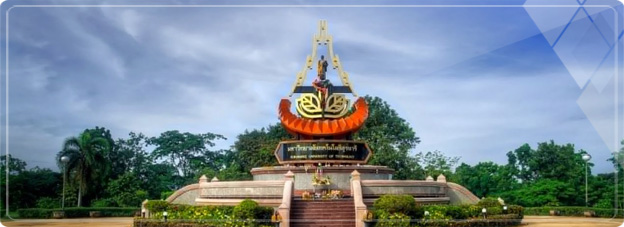
Administration and Governance of Suranaree University of Technology (SUT)
Development During the First Decade
The key operations and developments of Suranaree University of Technology during its first decade can be categorized into 3 distinct phases:
- Phase 1 (1988 – 1989): Land acquisition, organizational structure preparation, and master plan formulation.
- Phase 2 (1990 – 1993): The pioneering period focused on establishing physical infrastructure, utility systems, regulations, and staff recruitment, operating primarily from the temporary office in Bangkok.
- Phase 3 (1993 onwards): Full-scale operation at the main campus in Nakhon Ratchasima, enrolling the first batch of undergraduate students in Academic Year 1993, focusing on teaching and research, and expanding into academic services, technology transfer, and cultural preservation.
Organizational Structure
Governance and Policy Mechanisms
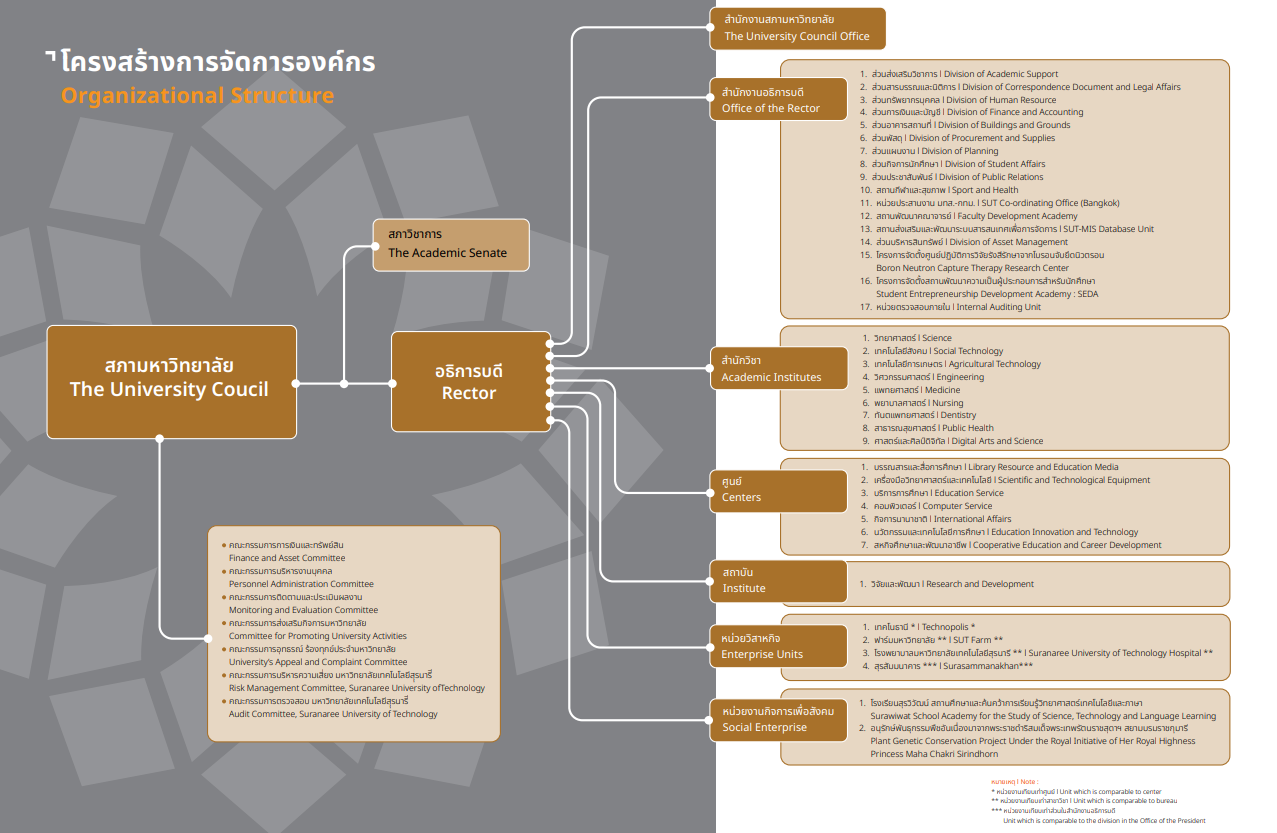
As a public autonomous university, SUT adheres to the principles of decentralization and self-governance. Decision-making authority culminates at the University Council level. The flat administrative structure prevents redundancy, while interdisciplinary clusters enhance operational flexibility.
Main Governing Bodies
- University Council: The supreme governing body supervising general affairs, policy, budget, property management, regulations, and executive appointments. It consists of the Council Chairman, ex-officio members (President, Federation of Thai Industries Chairman, Board of Trade Chairman), qualified external members (including 4 representatives from the Northeastern region), 2 representatives from the Academic Council, and 5 representatives from full-time faculty (2-year term). It is supported by 7 Standing Committees.
- Academic Council: Supervises academic affairs, instruction, research, and quality assurance. It consists of the President (Chairman), Deans, Center/Institute Directors, Professors, and 3 faculty representatives elected from each institute (2-year term).
Internal Organizational Units
1. Office of the President (17 Administrative Divisions)
- Division of Academic Support, Division of Correspondence and Legal Affairs, Division of Human Resources, Division of Finance and Accounting, Division of Buildings and Grounds, Division of Procurement and Supplies, Division of Planning, Division of Student Affairs, Division of Public Relations, SUT Sports and Health Center, SUT Bangkok Coordination Unit, Faculty Development Academy, Management Information System Development Center (MIS), Division of Asset Management, Boron Neutron Capture Therapy (BNCT) Research Center Establishment Project, Student Entrepreneurship Development Academy (SEDA) Project, and Center for Science, Technology, and Language Learning.
2. Academic Institutes (9 Institutes)
- Institute of Science, Institute of Social Technology, Institute of Agricultural Technology, Institute of Engineering, Institute of Medicine, Institute of Nursing, Institute of Dentistry, Institute of Public Health, and Institute of Digital Technology and Arts.
3. Support Centers & Research Institutes
- Centers (7 Centers): Center for Library Resources and Educational Media, Center for Scientific and Technological Equipment, Center for Educational Services, Center for Computer Services, Center for International Affairs, Center for Educational Innovation and Technology, and Center for Cooperative Education and Career Development.
- Institute (1 Institute): Research and Development Institute.
4. University Enterprises (Business-oriented self-reliance units)
- Technopolis: Provides academic services, conference hosting, training, consultation, and technology transfer.
- SUT Farm: Supports practical training, agricultural research, commercial farming, and sales of processed agricultural products.
- Suranaree University of Technology Hospital: Provides medical care and healthcare services to students, personnel, and the general public.
- Surasammanakhan (SUT Convention Center): Provides accommodation, catering, conference, and banquet services.
5. Social Enterprise Units
- Surawiwat School and Plant Genetic Conservation Project under the Royal Initiative of Her Royal Highness Princess Maha Chakri Sirindhorn (RSPG-SUT).
```